Home Renovation Designer Tips for Transforming Your Living Space
Reading time: 14 minutes
Ever walked into your own home and felt like a stranger? Like the space no longer reflects who you are or how you actually live? You’re not alone. In 2026, millions of homeowners are rethinking their living environments — not just for aesthetics, but for functionality, well-being, and long-term value. The good news? Transforming your living space doesn’t require a bottomless budget or a degree in architecture. It requires the right strategy, the right priorities, and a few designer secrets most people never hear about.
Well, here’s the straight talk: Successful home renovation isn’t about chasing every trend — it’s about creating a space that works for you, built to last, and designed with intention.
Whether you’re tackling a single room refresh or a whole-home overhaul, this guide will walk you through designer-level thinking, proven techniques, and real-world insights to help you transform your living space with confidence.
Table of Contents
- The State of Home Renovation in 2026
- Before You Pick Up a Paintbrush: Strategic Planning
- Core Design Principles Every Homeowner Should Know
- Room-by-Room Transformation Tips
- Budgeting Like a Pro: Where to Splurge and Where to Save
- Common Renovation Challenges and How to Overcome Them
- 2026 Home Renovation Priority Index
- Designer Material Comparison Table
- Frequently Asked Questions
- Your Renovation Roadmap: Next Steps
The State of Home Renovation in 2026
The home renovation industry has undergone a seismic shift in the past two years. According to the National Association of Home Builders (NAHB) 2026 Renovation Report, homeowners in the United States spent an estimated $472 billion on home improvement projects in 2025, a 14% increase from 2023. That number is projected to climb to $510 billion by the end of 2026.
What’s driving this surge? A combination of factors: remote and hybrid work arrangements have permanently changed how people use their homes, housing inventory remains tight in most major markets making moving less attractive, and a new generation of design-conscious millennials and Gen Z homeowners are entering the market with bold aesthetic ambitions and practical demands.
In 2026, the most sought-after renovation goals are:
- Multi-functional spaces — rooms that serve as offices, gyms, and entertaining areas simultaneously
- Biophilic design — incorporating natural elements like living walls, organic textures, and abundant natural light
- Smart home integration — seamlessly embedding technology into cabinetry, lighting, and climate control
- Sustainable materials — low-VOC paints, reclaimed wood, recycled tile, and energy-efficient fixtures
- Wellness-focused environments — air quality improvements, acoustic panels, and circadian lighting systems
As interior design consultant Jasmine Torres, founder of Torres Design Studio in Austin, Texas, explains: “The homeowners coming to us in 2026 aren’t asking ‘What looks good?’ They’re asking ‘What makes me feel good and work better?’ That’s a fundamental shift in the renovation conversation.”
Before You Pick Up a Paintbrush: Strategic Planning
One of the most expensive mistakes homeowners make is starting renovation work before completing a comprehensive plan. A rushed start leads to mid-project pivots, contractor confusion, cost overruns, and — most painfully — results you don’t actually love.
Define Your Renovation Goals Clearly
Before hiring anyone or purchasing a single tile, sit down and answer three foundational questions:
- What problem am I solving? — Is your kitchen dysfunctional? Does your bedroom feel chaotic? Is your home office a converted closet that’s crushing your productivity?
- How long do I plan to stay? — If you’re renovating to sell within two years, your priorities differ dramatically from someone building a forever home.
- What’s my non-negotiable? — Every homeowner has one thing they absolutely must have. Identifying it early prevents scope creep from pulling budget away from what matters most.
Quick Scenario: Imagine you’re a couple with two young children working from home three days a week. Your non-negotiable might be a dedicated, soundproofed home office. Your secondary goals might include upgrading the kitchen for family meals and creating a playroom that doubles as a guest room. That hierarchy shapes every decision — from budget allocation to contractor sequencing.
Build Your Design Brief
Professional interior designers always begin with a design brief — a document that captures the client’s lifestyle, aesthetic preferences, functional needs, timeline, and budget. You can create your own. Include:
- Inspiration images (Pinterest boards, magazine clippings, Instagram saves)
- Your preferred color palette and material preferences
- Specific functional requirements (storage needs, seating capacity, workflow patterns)
- Your realistic budget range with a 15-20% contingency buffer
- Timeline expectations and any hard deadlines
This document becomes your north star. When a contractor suggests an alternative, or you fall in love with an expensive tile in a showroom, your brief reminds you of your actual priorities and prevents costly emotional decisions.
Assemble the Right Team
Not every renovation requires a full interior design team. Here’s a practical framework for deciding who you actually need:
- Cosmetic updates (paint, fixtures, soft furnishings): DIY with designer consultation possible via online platforms like Modsy or Havenly
- Single-room renovation: Experienced general contractor plus a one-time interior designer consultation
- Structural changes or full-home renovation: Licensed architect + interior designer + general contractor with verified references
- New addition or major square footage change: Architect is legally required in most U.S. states and many international jurisdictions
Core Design Principles Every Homeowner Should Know
You don’t need to be a designer to think like one. A handful of foundational principles, applied consistently, will elevate any renovation from “nice” to genuinely impressive.
The 60-30-10 Color Rule
This is arguably the most powerful — and most underused — tool in residential design. The rule divides color usage in any room as follows:
- 60% — Dominant color (walls, large upholstered pieces, area rugs)
- 30% — Secondary color (curtains, accent chairs, bedding)
- 10% — Accent color (throw pillows, artwork, decorative objects, hardware)
This ratio creates visual harmony without monotony. The mistake most homeowners make is inverting this ratio — going bold on everything and wondering why the room feels overwhelming.
Scale, Proportion, and the Furniture Trap
The single biggest design error in residential interiors? Wrong-sized furniture. A sofa that’s too small for a large living room makes the room feel empty and poorly considered. Conversely, an oversized sectional crammed into a compact apartment creates a claustrophobic, chaotic energy.
Before purchasing any major furniture piece, tape out its dimensions on the floor with painter’s tape. Live with the footprint for a day. Walk around it. Imagine other pieces in the room. This simple technique — used by professional stagers and designers — prevents some of the most expensive and regrettable renovation decisions.
Lighting: The Most Underestimated Element
Lighting design in 2026 has evolved far beyond choosing a statement chandelier. Sophisticated homeowners now think in terms of lighting layers:
- Ambient lighting: General illumination (overhead fixtures, recessed lighting)
- Task lighting: Focused illumination for specific activities (under-cabinet kitchen lights, reading lamps, vanity lighting)
- Accent lighting: Directional lights that highlight architectural features or artwork
- Decorative lighting: Statement fixtures that function as visual art (sculptural pendants, neon installations, backlit panels)
A room lit by a single overhead fixture will always feel institutional and flat. Layering these light types — and controlling them separately with dimmers or smart switches — transforms the atmosphere of any space at any hour.
Room-by-Room Transformation Tips
Let’s get specific. Here are high-impact designer strategies for the rooms that matter most.
Kitchen: The Renovation ROI Champion
Kitchens consistently deliver the strongest return on renovation investment. In 2026, a mid-range kitchen renovation returns approximately 68-72% of its cost in added home value, according to Remodeling Magazine’s 2026 Cost vs. Value Report. Key strategies:
- Prioritize cabinet refacing over replacement when the layout and box structure are sound — it saves 40-60% compared to full replacement while delivering dramatic visual results
- Invest in countertops — they’re the most visually prominent surface and buyers notice them immediately. Quartz remains dominant in 2026 for its durability and low maintenance
- Update hardware — swapping cabinet pulls and knobs is a 2-hour project that costs under $200 and makes a disproportionate visual impact
- Consider the kitchen triangle — the efficient workflow relationship between sink, stove, and refrigerator. Any structural change should enhance, not disrupt, this triangle
Living Room: Your Design Statement
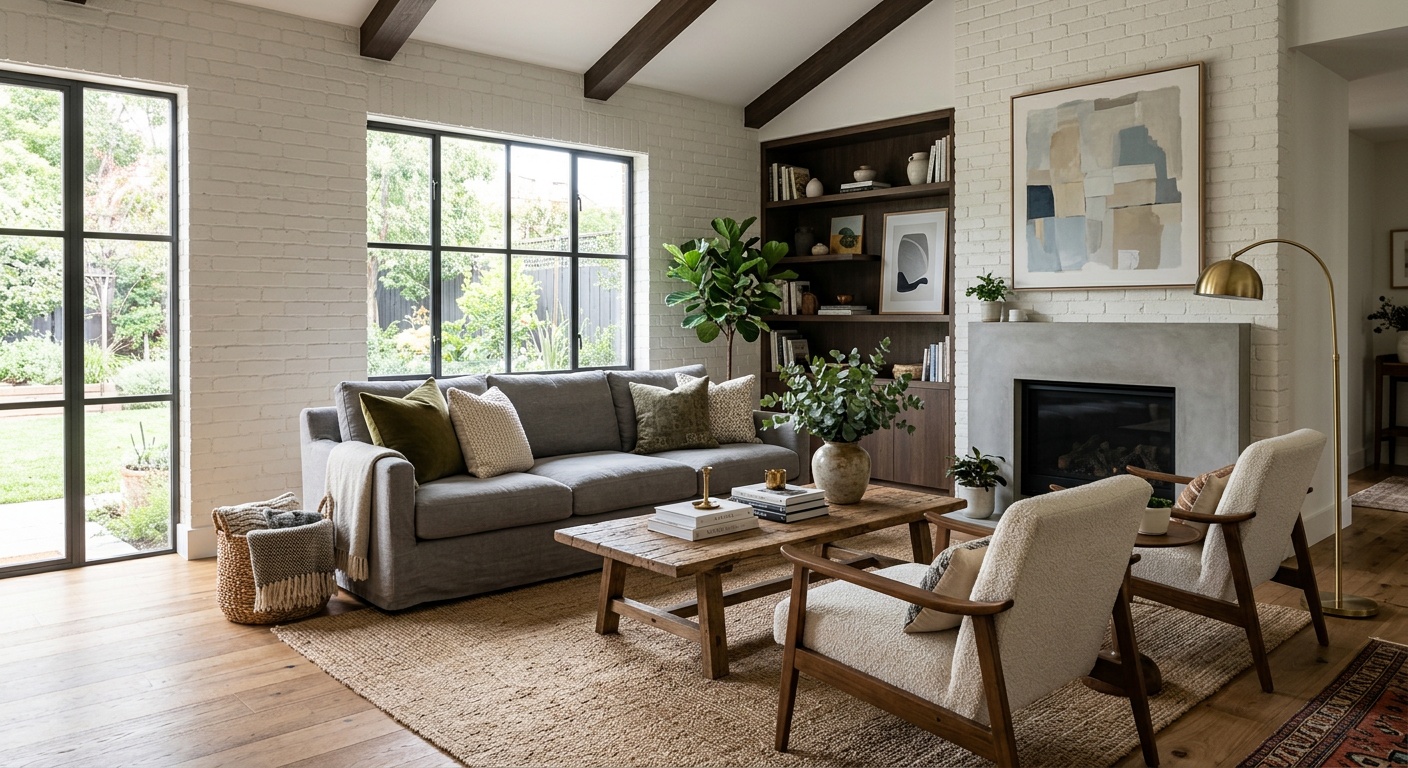
The living room is where design ambition meets everyday practicality. The 2026 trend moving away from formal, untouchable living rooms toward warm, layered, livable spaces is firmly established. Key moves:
- Anchor with a rug — the rug should be large enough that all major seating pieces have at least their front legs on it
- Create conversation zones — arrange seating to face each other at comfortable talking distances (8-10 feet), not all oriented toward a television
- Add architectural interest — board and batten paneling, ceiling beams, or a plastered accent wall add visual richness without major structural investment
Primary Bedroom: Your Sanctuary Strategy
Sleep quality research has fundamentally shifted how designers approach primary bedrooms in 2026. The bedroom is now treated as a circadian environment — a space engineered to support your body’s natural sleep-wake cycle. Practical implementation:
- Blackout solutions are non-negotiable — Roman shades with blackout lining, or drapery panels with a separate blackout liner layer
- Reduce visual noise — limit decorative objects, choose closed storage solutions, and avoid work equipment in the bedroom footprint
- Invest in your bedding — high-quality linen or organic cotton sheets and a properly weighted duvet have a measurable impact on perceived room quality
Budgeting Like a Pro: Where to Splurge and Where to Save
The art of renovation budgeting isn’t about spending as little as possible — it’s about spending wisely. Every dollar allocated to renovation has a different return in longevity, visual impact, and resale value.
Case Study — The Martinez Family, Denver, Colorado (2025): The Martinez family had a $55,000 budget for a comprehensive main floor renovation. Working with a designer, they made strategic allocations: $22,000 on kitchen countertops, cabinet refacing, and a new island; $14,000 on hardwood flooring that ran continuously through the open-plan space; $9,000 on recessed lighting installation and smart dimmer controls throughout; and $10,000 on living room architectural millwork and built-in shelving. By refusing to spend on new appliances (their existing ones worked perfectly), trendy decorative tile that would date quickly, or premium fixtures in the powder room, they achieved a result that their realtor estimated added $78,000 to their home’s market value.
The general principle: Spend on things that are structural or permanent (flooring, cabinetry, lighting infrastructure, countertops) and save on things that are easily swappable (light fixtures, hardware, soft furnishings, paint colors).
Common Renovation Challenges and How to Overcome Them
Even the best-planned renovations encounter friction. Here are the three most common challenges in 2026 and how experienced designers navigate them.
Challenge 1: Supply Chain Delays and Material Substitutions
Material lead times, while improved from their 2022-2023 peak, remain unpredictable in 2026. Certain specialty tiles, custom cabinetry, and imported stone can still carry 12-16 week lead times. The professional solution: Always order primary materials before work begins. Confirm delivery windows with your supplier before your contractor starts demo. Have one pre-approved backup option for each critical material selection. Flexibility built into the plan prevents paralysis when substitution becomes necessary.
Challenge 2: Scope Creep and Budget Overruns
Scope creep — the gradual expansion of a project beyond its original boundaries — is the silent budget killer. It often starts innocently: “While the contractor is here, let’s also do the hallway.” That one decision triggers additional materials, labor hours, and timeline extensions. The solution is a written change-order policy from day one. Any addition to the scope requires a written estimate and your written approval before work proceeds. No exceptions.
Challenge 3: The Design Decision Paralysis
With thousands of tile options, hundreds of paint colors, and infinite furniture configurations available at your fingertips, many homeowners freeze during the selection process. Designers call this decision fatigue. The professional approach: limit your consideration to three options for each selection, set a decision deadline, and trust the brief you wrote at the outset. When you’re torn between two countertop options, go back to your brief. Which one better serves your original goals?
2026 Home Renovation Priority Index
The following chart reflects data from the 2026 Houzz & Home Survey (surveying 47,000 U.S. homeowners), showing the percentage of renovating homeowners who cite each factor as a “top priority” in their current project:
Source: 2026 Houzz & Home Survey, n=47,000 U.S. homeowners
Designer Material Comparison: Making Smarter Surface Choices
One of the most confusing decisions homeowners face is choosing between competing surface materials. This table breaks down the most relevant considerations for kitchen and bathroom countertops in 2026:
| Material | Cost per sq ft (2026) | Durability | Maintenance Level | Best For |
|---|---|---|---|---|
| Quartz (Engineered) | $65–$120 | Excellent — scratch & stain resistant | Low (no sealing required) | High-use family kitchens |
| Natural Marble | $90–$200+ | Moderate — etches & stains with acids | High (annual sealing, careful use) | Bathrooms, low-use kitchens |
| Granite | $55–$110 | Very good — heat & scratch resistant | Moderate (sealing every 1-2 years) | Kitchens, outdoor applications |
| Sintered Stone (e.g., Dekton) | $85–$140 | Outstanding — UV, heat, scratch proof | Very Low (no sealing) | Indoor/outdoor, high-performance kitchens |
| Butcher Block (Wood) | $35–$80 | Good — water-sensitive without maintenance | Moderate (oiling every 3-6 months) | Island surfaces, warm aesthetic kitchens |
Frequently Asked Questions
How much should I budget for a full home renovation in 2026?
Industry benchmarks in 2026 suggest allocating between 5% and 15% of your home’s current market value for a comprehensive renovation. For a home valued at $450,000, that translates to a $22,500–$67,500 renovation budget. The wide range reflects the enormous variation in project scope, material quality, and regional labor costs. A practical framework: allocate roughly $100–$175 per square foot for a mid-range full renovation and $200–$350+ per square foot for a high-end finish level. Always hold back a 15-20% contingency reserve — unexpected discoveries behind walls (outdated wiring, plumbing issues, structural surprises) are common and can add $5,000–$20,000 to any project unexpectedly.
What renovations add the most value to a home in 2026?
According to the 2026 Cost vs. Value Report by Remodeling Magazine, the top-performing renovation investments in terms of ROI are: minor kitchen remodels (68-72% return), garage door replacement (85-93% return), entry door replacement (64-70% return), and deck or outdoor living space additions (60-68% return). It’s worth noting that “adding value” and “improving livability” don’t always align. A spectacular home theater might significantly enhance your daily enjoyment but return only 40-50% of its cost at resale. The best strategy is to prioritize renovations that align with both your lifestyle needs and your market’s buyer expectations.
Should I hire an interior designer or use DIY design platforms?
The honest answer depends on project scale and your own design confidence. For cosmetic updates — painting, styling, swapping fixtures — well-designed DIY platforms like Havenly, Decorist, or AI-powered design tools that have grown dramatically in capability through 2025 and 2026 can deliver excellent results at a fraction of the cost of a full design engagement. For structural renovations, multi-room overhauls, or projects where you’re making permanent architectural decisions, the investment in a professional interior designer typically pays for itself. A 2025 survey by the American Society of Interior Designers found that homeowners who used professional designers reported 23% fewer costly mid-project changes and significantly higher satisfaction with final results compared to homeowners who designed independently.
Your Renovation Roadmap: Transform Your Space with Intention
Here’s the truth that separates successful renovations from regretted ones: the homeowners who end up with extraordinary spaces aren’t the ones with the biggest budgets. They’re the ones with the clearest intentions, the most strategic plans, and the discipline to stay true to their vision when temptation or pressure pushes them sideways.
Here’s your practical roadmap to move forward with confidence:
- Write your design brief this week — Spend two hours documenting your goals, priorities, aesthetic preferences, and a realistic budget range. This single document will save you thousands of dollars and weeks of second-guessing.
- Conduct a room audit — Walk through each space you’re considering renovating and identify the one highest-impact change you could make. Often, it’s simpler than you think.
- Get three contractor quotes before committing — Not to find the cheapest option, but to understand the realistic cost landscape and to identify which contractor actually understands your vision.
- Order materials before demo day — Confirm material lead times and have your primary selections in hand before any demolition begins. This alone eliminates 60% of common renovation delays.
- Schedule a design review at the halfway point — Step back mid-project to assess alignment with your original brief. Catching drift early is exponentially cheaper than correcting it after completion.
The broader context here matters: as homes continue to function as offices, gyms, schools, and entertainment venues well into the late 2020s, the quality of your living environment has a direct, measurable impact on your productivity, mental health, and quality of life. Renovation isn’t a luxury — for many people in 2026, it’s a strategic investment in how they live, work, and feel every single day.
So here’s the question worth sitting with: What would your ideal living space actually enable you to do, create, or become — and what’s the first concrete step you’re willing to take this week to make that a reality?
Your home is already telling a story. The renovation is just your chance to make sure it’s the right one.
About the Author
