Designing a Safe and Stylish Nursery Room at Home
Reading time: 12 minutes
You’ve just found out you’re expecting — or maybe the due date is weeks away and that spare room is still an empty box of potential. Either way, designing a nursery can feel equal parts thrilling and overwhelming. Where do you even start? Safety standards? Color palettes? That $900 glider everyone on parenting forums swears by?
Here’s the straight talk: a great nursery isn’t about perfection or an unlimited budget. It’s about making smart, informed decisions that protect your baby while creating a space you’ll actually enjoy spending time in — because trust us, you’ll be logging serious hours in that room.
In 2026, nursery design has evolved significantly. Parents are balancing sustainability, smart-home technology, and stricter safety consciousness in ways previous generations never had to consider. This guide cuts through the noise and gives you a practical, room-by-room roadmap — combining expert insights, real-world examples, and current standards to help you build a nursery that’s both breathtakingly stylish and genuinely safe.
Table of Contents
- Safety First: The Non-Negotiables
- Choosing the Right Furniture
- Air Quality, Temperature, and Comfort
- Style Without Sacrifice: Aesthetics That Work
- Lighting for Sleep and Play
- Common Nursery Mistakes and How to Avoid Them
- Nursery Essentials: Feature Comparison
- FAQs
- Your Nursery, Ready for Real Life: Next Steps
Safety First: The Non-Negotiables
Before you pin a single mood board image, let’s talk about the framework that everything else hangs on: safety. According to the American Academy of Pediatrics (AAP) 2025 updated safe sleep guidelines, sleep-related infant deaths still account for approximately 3,500 fatalities annually in the United States alone — the vast majority of which are preventable with the right environment.
That number is sobering. But it also means that the choices you make in this room carry real weight, and that’s empowering rather than paralyzing once you know what to prioritize.
The Safe Sleep Environment
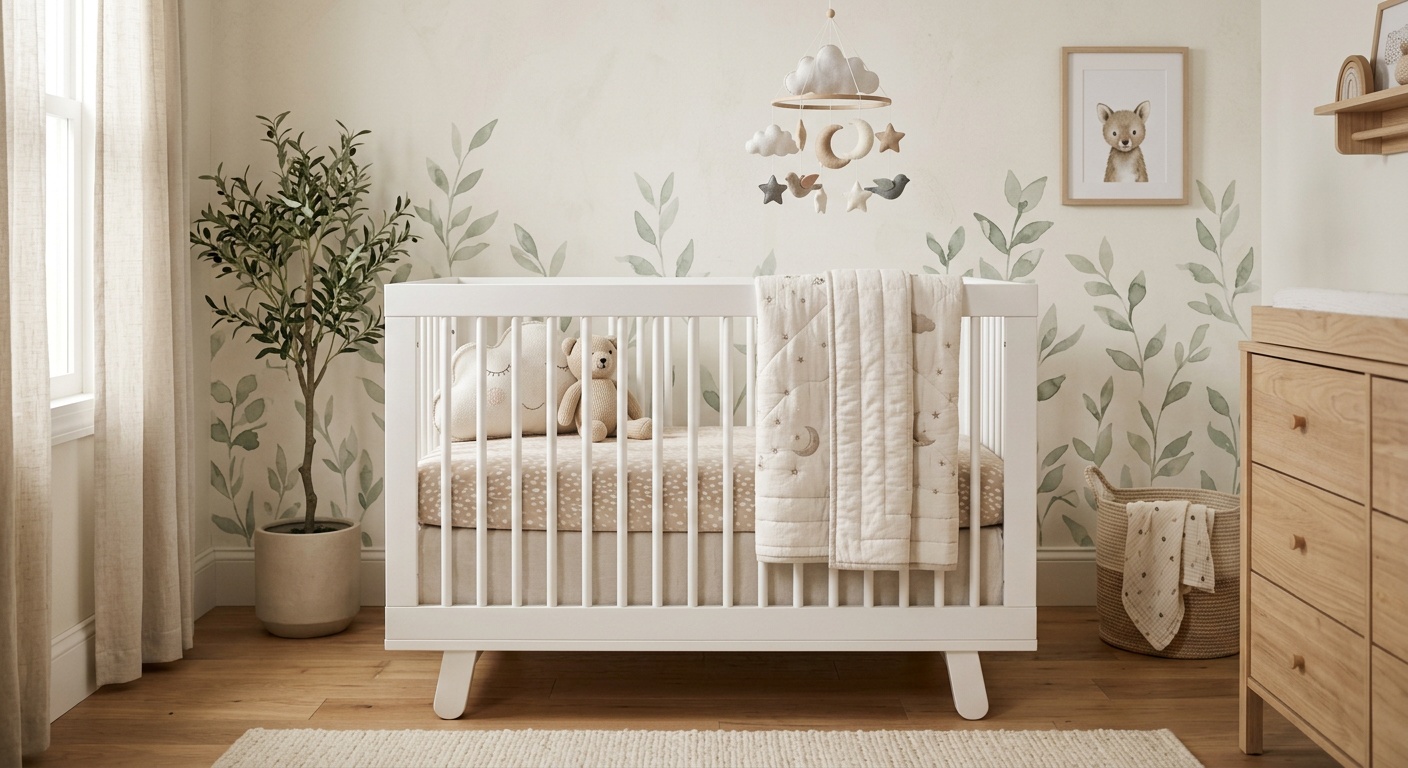
Think of the sleep space as the heart of your nursery — everything radiates outward from it. The AAP recommends a firm, flat sleep surface with no loose bedding, pillows, positioners, or bumpers. A bare crib is a safe crib. That visual might feel stark to design-minded parents, but there are tasteful ways to create warmth around the crib without putting anything dangerous inside it.
When selecting your baby crib, always verify that it meets current CPSC (Consumer Product Safety Commission) standards. Since 2011, drop-side cribs have been banned in the U.S., and in 2026, new ASTM International standards require additional structural integrity testing for convertible cribs. Always register your crib with the manufacturer so you receive recall notices promptly.
Quick Safety Checklist for the Crib Area:
- Slats spaced no more than 2⅜ inches apart
- Mattress fits snugly (no more than two finger-widths of space between mattress and crib frame)
- No cords, strings, or window blind pulls within reach
- Crib placed away from heaters, fans, and direct sunlight
- No mobiles with strings once baby can push up on hands and knees
Anchoring Furniture and Childproofing for the Long Game
Many parents anchor furniture reactively — after a toddler pulls a dresser. Design for the next two years, not just the newborn phase. The U.S. CPSC reported that between 2020 and 2025, furniture tip-over incidents injured an average of 22,500 children per year. Anti-tip straps cost under $20 and take fifteen minutes to install. Use them on every piece of freestanding furniture in the nursery from day one.
Cover all electrical outlets with tamper-resistant plates (standard in new construction since 2008, but worth checking in older homes). Use cord management channels for monitor cables and lamp cords. If you’re painting, verify the paint is zero-VOC — not just “low-VOC.” In 2026, many major paint brands like Sherwin-Williams, Benjamin Moore, and Clare now offer certified zero-VOC lines as their standard options, making this easier than ever.
Choosing the Right Furniture
Nursery furniture serves a unique dual purpose: it needs to be functional enough for the exhausted, sleep-deprived version of you at 3 a.m., and durable enough to grow with your child. Here’s how to think strategically about each major piece.
The Crib: Your Biggest Decision
A convertible crib that transitions to a toddler bed and then a full-size bed is one of the smartest investments you can make. Brands like IKEA’s SUNDVIK line, Pottery Barn Kids, and Million Dollar Baby Classic all offer JPMA-certified convertible options that don’t require you to buy a new bed at every developmental stage. In 2025, average convertible crib prices ranged from $250 to $900, with mid-range options consistently receiving the best safety and durability reviews.
Consider this: Emma and Josh, first-time parents in Seattle, spent $340 on a convertible crib in 2024 and were able to transition it to a toddler bed by 2026 without purchasing a single additional piece of furniture. The long-term math is straightforward.
The Glider or Rocking Chair
You will spend hundreds of hours in this chair. Prioritize lumbar support, armrest height relative to your elbows, and ease of getting up one-handed (because the other hand will be holding a sleeping baby). Look for chairs with non-toxic upholstery labeled OEKO-TEX certified. Avoid chairs with exposed metal mechanisms that could pinch fingers as the child grows and becomes curious.
The Changing Table
A standalone changing table is a luxury of space. If your nursery is compact — a common reality in 2026’s urban housing market — a dresser-topper changing pad with a safety strap is functionally identical and saves considerable square footage. Whichever route you choose, never leave a baby unattended on an elevated surface. Position the changing station near the door so you can hear and respond to other children or household sounds without stretching across the room.
Air Quality, Temperature, and Comfort
This is one of the most technically nuanced areas of nursery design — and one that gets surprisingly little coverage in typical “nursery reveal” content.
The AAP recommends keeping a baby’s room between 68°F and 72°F (20°C–22°C) year-round. That range supports both safe sleep temperature regulation and reduces the risk of SIDS, which has been associated with overheating. Maintaining that range consistently is harder than it sounds, particularly during summer months or in climates with dramatic temperature swings.
Many parents wonder whether cooling appliances are safe near infants. The answer depends heavily on device type, placement, and airflow direction. A room air conditioner on a high wall mount, directed away from the crib, is generally considered safe. Portable evaporative coolers and personal air coolers raise more questions, and it’s worth reading detailed guidance on whether is air cooler safe for babies before making a purchase decision — the nuances around humidity levels and airflow direction matter more than most people realize.
Air Quality Beyond Temperature
Temperature is only half the equation. Indoor air quality in 2026 is a growing concern — the EPA estimates that indoor air can be 2 to 5 times more polluted than outdoor air, due to off-gassing from furniture, carpets, paints, and cleaning products. For a nursery, this matters enormously because infants breathe 40 to 60 times per minute (compared to 12 to 20 times for adults), meaning they’re processing significantly more air volume relative to body weight.
Practical air quality steps:
- Air out new furniture for 2–4 weeks before the baby arrives (off-gassing peaks in the first 30 days)
- Use a HEPA air purifier rated for the room’s square footage — place it at floor level, away from the crib
- Choose solid wood furniture over MDF or particleboard where possible (less formaldehyde emission)
- Opt for hardwood or low-pile rugs over wall-to-wall carpet (carpets trap allergens and are harder to clean)
- Use fragrance-free, plant-based cleaning products in the nursery
A small, quiet humidifier can also help during dry winter months, maintaining humidity between 40% and 60% — the sweet spot for respiratory comfort and dust mite reduction simultaneously.
Style Without Sacrifice: Aesthetics That Work
Here’s where the fun starts — and where many parents make their biggest stylistic mistakes by letting trends override practicality. The good news: in 2026, the dominant nursery design trends are actually highly compatible with safety and longevity.
The top nursery design trends of 2026 include:
- Biophilic design — incorporating natural textures, wood tones, and botanical elements
- Earthy, muted palettes — sage green, terracotta, warm whites, and clay tones replacing the all-white minimalism of the 2010s
- Gender-neutral spaces — intentional design choices that aren’t tied to pink/blue binaries
- Multi-use zones — spaces that serve as play areas, reading nooks, and sleep environments
- Vintage and sustainable elements — secondhand furniture restored with safe paint and vintage textiles
These trends are actually aligned with safety-conscious design. Natural materials off-gas less. Muted, non-stimulating colors support sleep. Multi-use thinking reduces furniture clutter. If you’re designing on a budget, biophilic aesthetics are achievable with potted plants (placed well out of reach), woven baskets for toy storage, and inexpensive wooden wall art.
Case Study: The 180-Square-Foot Urban Nursery
Consider the challenge Maria and David faced in Chicago in late 2025. Their nursery space was a 12×15-foot room in a 1940s apartment — no closet, original hardwood floors, and a single window facing west. Their goals: safe sleep environment, sustainable materials, under $2,000 total budget.
Their solution involved a natural beech convertible crib ($380, JPMA-certified), a wall-mounted fold-down changing table to save floor space ($190), a secondhand glider reupholstered with OEKO-TEX certified fabric ($110 total), sage green zero-VOC paint from Clare ($95 for two gallons), a woven jute rug ($140), and a simple HEPA air purifier ($120). Total spend: $1,035. The result was photographed for a local parenting blog and became one of the most-shared nursery reveals in Chicago parenting groups in early 2026 — precisely because it was achievable and honest about its constraints.
The lesson: working with limitations rather than against them almost always produces more authentic, livable spaces.
Lighting for Sleep and Play
Lighting is the element that most transforms a room’s feel — and in a nursery, it pulls triple duty: functional task lighting for diaper changes and feedings, ambient lighting for play, and sleep-supporting lighting for nap and bedtime routines.
Avoid harsh overhead fluorescent lighting. Instead, think in layers:
- Primary lighting: A dimmable overhead fixture with warm-toned (2700K–3000K) LED bulbs
- Task lighting: A small, adjustable lamp near the changing area — never pointed directly at the baby’s eyes
- Night lighting: A plug-in nightlight with a red or amber setting (these wavelengths have the least impact on melatonin production)
Smart dimmers in 2026 have become remarkably affordable. Brands like Lutron and Leviton offer nursery-compatible dimmers starting at $25–$35 that can be app-controlled, letting you reduce lighting without a switch click that might wake a sleeping baby. This is one of the highest-value upgrades you can make for under $50.
Pro Tip: Install blackout curtains. Full blackout, not light-filtering — there’s a meaningful difference. In 2026, blackout curtain liners can be added to any decorative curtain for $20–$40, maintaining your aesthetic while providing genuine light blocking that supports daytime nap schedules.
Common Nursery Mistakes and How to Avoid Them
Even well-researched parents make predictable errors. Here are the three most common — and how to sidestep them.
Mistake 1: Over-Decorating the Crib Area
It’s visually tempting to create a “styled” crib with decorative pillows, a canopy, bumpers, and plush toys. This is genuinely dangerous. Anything in or draped over the crib creates suffocation or entanglement risk. The styling energy belongs on the walls, the bookshelf, the mobile (safely mounted above reach), and the window treatment — not inside or directly over the sleep space.
Mistake 2: Prioritizing Aesthetics Over Storage
Babies generate a staggering volume of stuff. Without adequate, organized storage, the room becomes chaotic quickly — and clutter in a small space creates both tripping hazards and increased stress. Plan for at least one dedicated storage solution: a dresser with deep drawers, a closet organizer system, or a combination of baskets and shelving. Label everything. Future-tired-you will be grateful.
Mistake 3: Setting Up the Room Too Early Without Off-Gassing Time
New furniture, fresh paint, new carpet, and new textiles all release volatile organic compounds (VOCs) at their highest rate in the first 30 days after installation or opening. If possible, set up the nursery 4–6 weeks before the due date with windows open as much as weather permits, and run an air purifier continuously during that period. This one step meaningfully improves the air quality your newborn enters.
Nursery Essentials: Feature Comparison
| Item | Budget Option | Mid-Range Option | Premium Option | Key Safety Feature |
|---|---|---|---|---|
| Crib | IKEA SUNDVIK (~$200) | Million Dollar Baby (~$450) | Restoration Hardware (~$950) | CPSC & ASTM certified |
| Glider/Rocker | Graco Hadley (~$180) | Pottery Barn Swivel (~$599) | DUX Nursery Chair (~$1,400) | OEKO-TEX fabric, lumbar support |
| Air Purifier | Levoit Core 300 (~$90) | Coway AP-1512HH (~$140) | Dyson Purifier (~$550) | True HEPA, room-size matched |
| Monitor | VTech VM819 (~$55) | Nanit Pro (~$300) | Owlet Dream Duo (~$399) | Encrypted signal, cord management |
| Paint | BEHR Premium (~$35/gal) | Clare Paint (~$49/gal) | Portola Roman Clay (~$115/gal) | Zero-VOC certified |
Nursery Safety Priority Ratings (2026 Parent Survey)
Based on a 2025 survey of 1,200 U.S. parents planning nurseries, here are the top safety concerns ranked by importance:
Frequently Asked Questions
How far in advance should I set up the nursery before the baby arrives?
Ideally, complete your nursery setup 6 to 8 weeks before your due date. This timeline serves two critical purposes: it gives new furniture, paint, and flooring adequate time to off-gas VOCs (with windows open and an air purifier running), and it gives you a buffer in case baby arrives early — which happens in roughly 10% of pregnancies. Avoid leaving setup for the final two weeks, when both physical comfort and cognitive bandwidth are at their lowest. The practical sweet spot is completing assembly at week 34 and decorating detail work at week 36.
What’s the safest nursery flooring option for 2026?
Solid hardwood or engineered hardwood with a low-VOC finish is consistently rated the safest nursery flooring choice by indoor air quality experts. It doesn’t trap allergens, is easy to clean, and doesn’t off-gas formaldehyde the way standard laminate or wall-to-wall carpet often does. If budget is a constraint, luxury vinyl plank (LVP) with FloorScore certification is a solid alternative. If you choose LVP, look explicitly for FloorScore or GREENGUARD Gold certification on the packaging — these are independent verifications, not manufacturer claims. Add a machine-washable, non-slip area rug for warmth and sensory stimulation during floor play time.
Do I need a baby monitor if the nursery is close to our bedroom?
Even in small homes where the nursery shares a wall with the master bedroom, a monitor is strongly recommended. The key reason isn’t distance — it’s that monitors allow you to observe your baby’s breathing patterns, room temperature, and activity without opening the door and potentially disturbing a lightly sleeping infant. In 2026, mid-range video monitors with built-in room temperature displays (like the Nanit Pro) provide genuinely useful data. If budget is a concern, even an inexpensive audio monitor is meaningfully better than relying on your ability to hear through walls while sleeping. Look for monitors with encrypted signals to prevent wireless signal interception — an increasingly important consideration given the proliferation of connected home devices.
Your Nursery, Ready for Real Life: Next Steps
You’ve covered the full arc — from safe sleep fundamentals to stylish, sustainable design choices. Now let’s translate that into concrete action. Here’s your practical implementation roadmap:
- Week 1 — Safety audit first: Walk the room with fresh eyes and a checklist. Identify cord hazards, outlet placement, window proximity, and furniture anchor needs before anything else goes in.
- Week 2–3 — Furniture selection and delivery: Prioritize crib, dresser, and glider. Order early — supply chain delays still affect nursery furniture in 2026, and popular items can have 4–6 week lead times.
- Week 4 — Off-gassing phase: All furniture assembled, windows open daily, air purifier running. Paint already applied. Let the room breathe.
- Week 5–6 — Layering comfort and aesthetics: Add textiles, lighting, decor, and storage solutions. This is when the room comes alive visually.
- Week 7 — Final safety walkthrough: Revisit your checklist. Check all furniture anchors, confirm the crib mattress fit, test the monitor, verify temperature consistency, and confirm blackout curtains block light effectively.
The broader implication here is significant: as smart-home technology, sustainable materials, and infant safety research continue to advance rapidly through 2026 and beyond, the nursery has become one of the most intentionally designed spaces in modern homes — a reflection of how seriously today’s parents take evidence-based parenting from day one.
Here’s a thought worth sitting with: What does the environment you’re creating tell your child about how deeply they’re valued before they can even understand it? A nursery built with care, knowledge, and genuine intention answers that question before words ever can. Start with safety. Layer in beauty. And give yourself permission to iterate — the best nurseries evolve with the child who grows up in them.
About the Author
